
Australia Spouse Visa:
The State of Partner Migration in 2026
The Australia Spouse Visa (officially the Partner Visa) remains the most sought-after family migration pathway in the Australian immigration system. In 2026, the Department of Home Affairs (DHA) has shifted toward a “High-Integrity” model, meaning that the standard for proving a “genuine and continuing relationship” is higher than ever before.
For couples, this visa is not just a paperwork exercise; it is a significant financial and emotional investment. With application fees now at record levels and processing times spanning years, a “trial and error” approach is no longer viable. This guide provides a professional, step-by-step roadmap to navigating the complexity of the Partner Visa Australia (Subclasses 820, 801, 309, and 100), ensuring your application stands up to the most rigorous scrutiny.
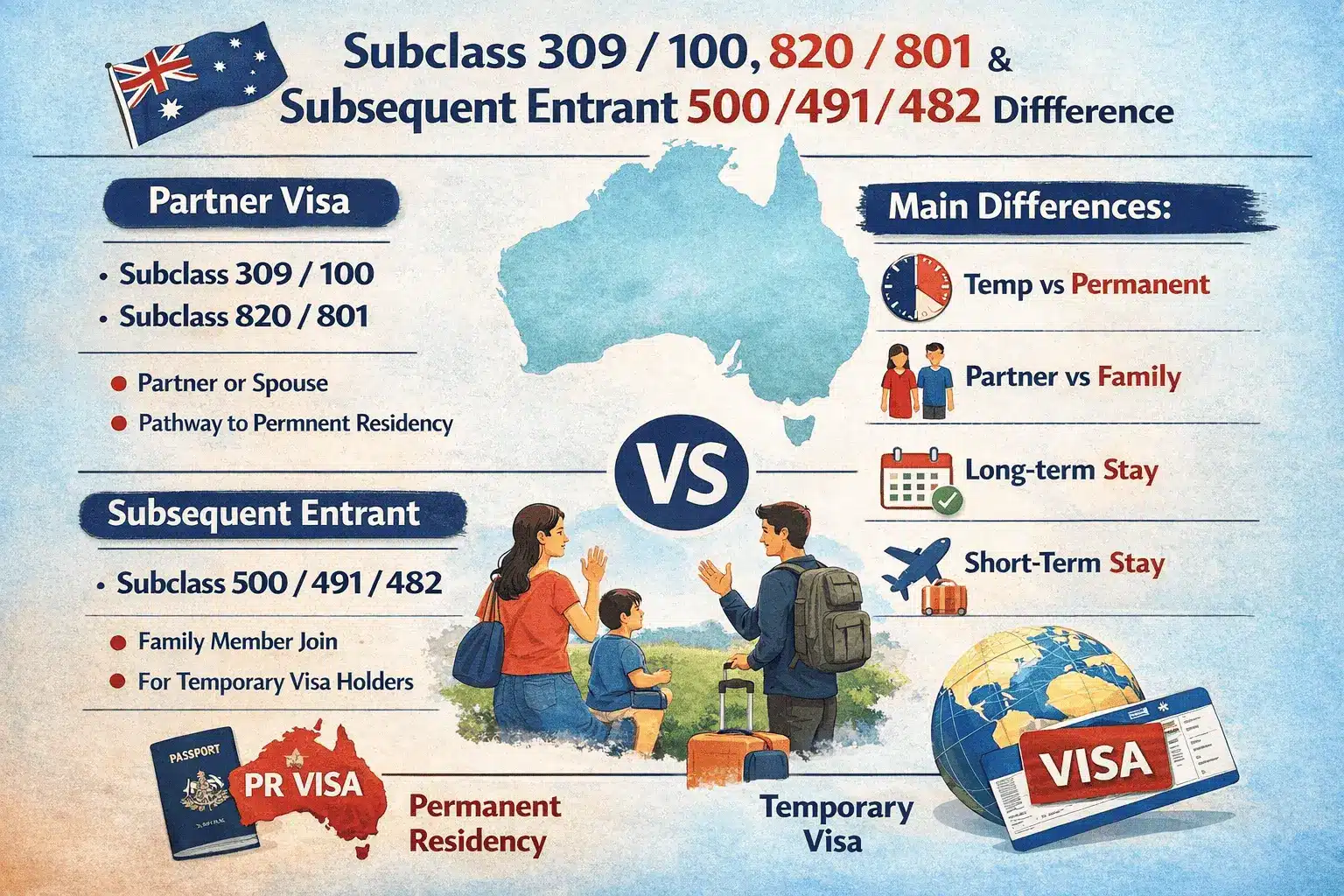
Understanding the Partner Visa Ecosystem
The Australian Spouse Visa is a “combined application.” When you apply, you are technically lodging two applications at once: one for a Temporary Visa and one for a Permanent Visa.
The Two-Stage Journey
- Stage 1 (Provisional): You are granted a temporary visa (Subclass 820 for onshore or 309 for offshore). This allows the applicant to live, work, and study in Australia while the government monitors the relationship for a further two years.
- Stage 2 (Migrant): Two years after the initial lodgment, the Department assesses whether the relationship is still ongoing. If successful, you are granted a Permanent Visa (Subclass 801 or 100).
Subclass Breakdown
- Subclass 820/801 (Onshore): For applicants physically located in Australia at the time of lodgment. These applicants usually receive a Bridging Visa, allowing them to stay in the country during processing.
- Subclass 309/100 (Offshore): For applicants living outside Australia. This is the primary path for partners waiting to join their loved ones from abroad.
- Subclass 300 (Prospective Marriage): For engaged couples. This “fiancé visa” allows the partner to enter Australia for 9–15 months to marry their sponsor, after which they transition to the 820/801 stream.
Eligibility Criteria: Who Can Apply?
To be a valid applicant or sponsor in 2026, you must meet specific legal thresholds.
Sponsor Requirements
The sponsor must be an Australian citizen, a permanent resident, or an “eligible New Zealand citizen.” Sponsors are legally responsible for their partner’s financial obligations for the first two years in Australia.
- Sponsorship Limitations: In 2026, you generally cannot sponsor more than two partners in a lifetime, and there must be at least a 5-year gap between sponsorships.
- Character Checks: Sponsors must now provide police clearances. If a sponsor has a “significant criminal record” (especially involving domestic violence), the sponsorship may be refused.
Relationship Requirements
You must be either legally married or in a de facto relationship.
- De Facto Definition: You must prove you have been living together and sharing a life for at least 12 months before applying.
- Waivers: The 12-month requirement can be waived if the couple has a dependent child together or if the relationship is officially registered with an Australian State or Territory (e.g., NSW, VIC, QLD).
The 4 Pillars of Evidence: A Masterclass
The DHA does not just look at a marriage certificate; they look at the “social and financial fabric” of your life. Every application is assessed against these four pillars.
1. Financial Aspect
The Department looks for “financial interdependence.” You must show you operate as a single financial unit.
- Evidence: Joint bank account statements showing regular household transactions (groceries, rent, bills), joint ownership of major assets (cars, property), and naming each other as beneficiaries in wills or superannuation.
2. Nature of the Household
This pillar proves you are not just “dating” but actually living together.
- Evidence: Joint lease agreements, utility bills in both names, mail addressed to both of you at the same address, and a written statement explaining how you divide household chores and responsibilities.
3. Social Recognition
How does the world see you? A “secret” relationship will be refused.
- Evidence: Statutory Declarations (Form 888) from Australian friends and family, joint invitations to social events, photos of you together with other people, and evidence of joint travel (flight itineraries/hotel bookings).
4. Nature of Commitment
This proves your intention for a long-term, exclusive future.
- Evidence: Detailed “Relationship History Statements” from both parties, proof of staying in touch during periods of separation, and knowledge of each other’s personal backgrounds and families.
Australia Spouse Visa Costs (2026 Updated)
Migration to Australia is a significant financial commitment. As of July 1, 2025, and continuing through 2026, fees have been indexed to reflect inflation.
| Fee Category | Cost (AUD) |
| Main Applicant (820/801 or 309/100) | $9,365 |
| Additional Applicant (Over 18) | $4,685 |
| Additional Applicant (Under 18) | $2,345 |
| Prospective Marriage (Subclass 300) | $9,365 |
| Transition from 300 to 820 | $1,560 |
Hidden Costs to Budget For:
- Credit Card Surcharge (1.4%): Approx. $131.
- Medical Exams: $350 – $600 per person.
- Police Clearances: $50 – $200 per country.
- Translation Services: $200 – $1,000 (for non-English documents).
Step-by-Step Application Roadmap
Step 1: Strategy and Subclass Selection
Ensure you are applying for the correct subclass. If you are onshore on a visa with a “No Further Stay” condition (8503), you must seek a waiver before lodging.
Step 2: Documentation (The “Decision-Ready” Approach)
In 2026, the DHA prioritizes applications that are “front-loaded.” This means uploading your medicals and police checks at the time of lodgment rather than waiting for an officer to ask for them.
Step 3: Lodgment via ImmiAccount
The applicant lodges first, pays the fee, and then provides the Transaction Reference Number (TRN) to the sponsor. The sponsor then lodges their “Sponsorship” form separately.
Step 4: Bridging Visa & Medicare (Onshore Only)
Onshore applicants are granted a Bridging Visa A (BVA), which usually includes full work rights. Crucially, you can also enroll in Medicare immediately upon lodgment of the 820/801.
Processing Times: Managing Expectations
As of March 2026, processing times are as follows:
- Temporary Stage (820/309): 12–24 months.
- Permanent Stage (801/100): Eligible 2 years after lodgment; processing takes 6–12 months.
Why the variation? Factors like the number of dependent children, previous visa refusals, or the complexity of your character checks (if you’ve lived in many countries) can extend the timeline.
Common Refusal Pitfalls
- Inconsistent Dates: Ensure the date you “met” and the date you “committed” are the same across all documents.
- Weak Financials: A joint bank account opened just one week before applying is a major red flag.
- Form 888 Errors: Statutory declarations must be from people who have actually spent time with you as a couple.
- Health/Character Issues: Failing to disclose a medical condition or a minor criminal conviction can lead to a “Public Interest Criterion” refusal.
Strategic FAQ: Your 2026 Queries Answered
Q: Can I apply for the Spouse Visa if I am on a Tourist Visa?
A: Yes, provided your Tourist Visa does not have a “Condition 8503 – No Further Stay.” If it does, you must apply to have it waived or leave the country to apply offshore.
Q: What happens if our relationship breaks down during processing?
A: Generally, the visa will be refused. However, there are Family Violence Provisions. If the applicant has experienced domestic violence, they may still be eligible for permanent residency even if the relationship has ended.
Q: Do we need to be living together for exactly 12 months?
A: For de facto partners, yes. However, registering your relationship with the State government (like the NSW Relationship Register) legally “waives” the 12-month living requirement for visa purposes, though you still need to prove the relationship is genuine.
Q: Can I travel outside Australia while my 820 is processing?
A: If you are on a Bridging Visa A, you must apply for a Bridging Visa B (BVB) before leaving Australia to ensure you can return.
Q: Is an interview mandatory?
A: No, but the DHA is increasing the use of “spot-check” interviews in 2026 to combat fraud. Be prepared to answer questions about your partner’s family, daily habits, and future plans.