Australia: A nation built on immigration
Australia is, by almost any measure, one of the world’s great immigration stories. It didn’t just accept migrants — it built itself around them. And the numbers today reflect that heritage in full.
The big picture
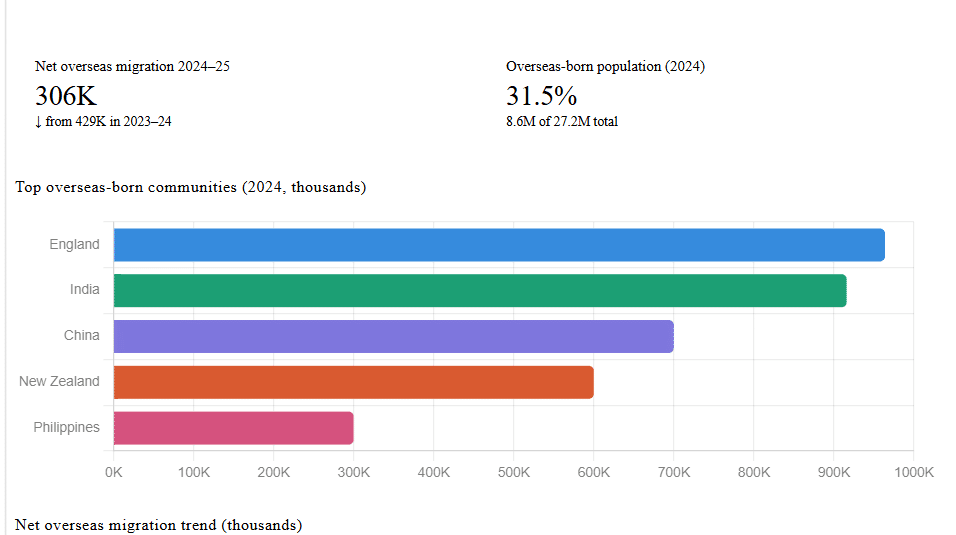
As of June 2024, Australia’s estimated resident population was 27.2 million, of whom 8.6 million were born overseas — meaning nearly one in three Australians arrived from somewhere else. Australian Bureau of Statistics Among major Western nations, immigrants account for roughly 30% of the population, the highest proportion of any comparable country. Wikipedia
Net overseas migration (NOM) — the measure of how much immigration adds to population — was 306,000 in 2024–25, a notable cooling from the post-COVID peak of 429,000 the year prior. Australian Bureau of Statistics To put that in historical perspective, NOM stood at just 30,042 in 1992–93, climbed to 178,582 in 2015–16, rocketed to a record 536,000 in 2022–23, and is now projected to settle around 260,000 for 2025–26. Wikipedia
Where do migrants come from?
The source countries have shifted dramatically over the decades. For most of Australia’s post-war history, the British Isles dominated. That’s still partly true, but South and East Asia have fundamentally reshaped the picture.
As of 2024, the four largest overseas-born communities are: England (964,000), India (916,000), China (700,000), and New Zealand — and these four groups alone account for over a third of all overseas-born Australians. Australian Bureau of Statistics
India is the fastest-growing community of the past decade, having recorded the largest increase since 2014. The Indian-born population has now nearly reached the top spot, recently surpassing China’s community. Australian Bureau of Statistics
In terms of who is arriving right now, the 2024–25 top five source countries for arrivals were India, China, the United Kingdom, Australia (returning expats), and New Zealand. The broader regional shift is striking: in 2014–15, the largest group of arrivals (21%) came from North-East Asia, but by 2024–25 Southern and Central Asia dominates at 26% of all arrivals. Australian Bureau of Statistics
How do people get in?
Australia runs a structured, points-based immigration system with three main pathways:
Skill stream is the backbone. It made up 71.4% of the 185,001 permanent places delivered in 2024–25, with employer-sponsored, independent, and regionally-nominated visas forming the core categories. Department of Home Affairs The government also launched the Skills in Demand (SID) visa in December 2024, replacing the old Temporary Skill Shortage visa. The SID visa has three streams based on salary thresholds — Specialist Skills, Core Skills, and a Labour Agreement stream — and offers a clearer route to permanent residence for holders. OECD
Family stream accounts for around 28% of places and is primarily for partners and children of Australian citizens or permanent residents.
Temporary pathways are where the volume really shows. In 2024–25, migrant arrivals included 157,000 international students (the largest single group), 78,000 working holiday makers, 56,000 visitors who stayed long enough to count as migrants, and 46,000 temporary skilled workers. Australian Bureau of Statistics A significant share of people who eventually gain permanent residence come through the temporary route first: more than half of migrants who obtained a permanent place in 2024–25 were already in Australia on a temporary visa. Department of Home Affairs
Why Australia?
In 2023, the Boston Consulting Group ranked Australia as the top country destination for individuals seeking to work and live a high-quality life, based on global assessments. Wikipedia The pull factors are well-established: Medicare, world-class universities, relatively high wages, political stability, and a multicultural social fabric that makes settlement smoother. The overseas-born communities themselves become a draw — shared language and cultural networks help new arrivals settle, and employers benefit from the diverse skill sets migrants bring. VisaVerge

Tensions and debates
The surge in post-COVID immigration has not been without controversy. A December 2023 survey found that 74% of voters preferred lower net migration, and a 2024 Scanlon Foundation survey showed 49% felt migration levels were too high. Wikipedia
The core tension is housing. The government has tried to reduce NOM through capped permanent visa places, stricter student visa rules, and tighter compliance — but experts warn that cutting migration without redirecting settlement to regional areas risks deepening labour shortages outside major cities. SBS Students, in particular, are a tricky case: student visa lodgements dropped to about 427,000 in 2024–25, down from nearly 600,000 the year prior, as the government tightened English proficiency, financial requirements, and scrutiny of applications. SBS
Australians leaving
Migration isn’t a one-way street. In 2023, emigration of Australian citizens to OECD countries reached 22,000, with roughly 24% heading to New Zealand, 19% to the UK, and 16% to the United States. OECD Australia has a long tradition of its own citizens working abroad, particularly in London and the US tech sector, before often returning home.
Australia’s immigration story is, at its core, one of managed transformation. The country has gone from a 90%-British settler population in the mid-20th century to a genuinely global society — and the data suggests that trajectory isn’t slowing down anytime soon, even as policy tightens around the edges.