
491 Visa: Your Easy Pathway to Australia
The Subclass 491 is Australia’s regional skilled migration visa — a provisional, five-year visa that gives skilled workers a clear, structured pathway to permanent residency through regional living and work. It is not a lesser option. For most skilled migrants worldwide, it is the smartest entry point into Australian PR.
If you have a first blood relative in Australia who is a PR or citizen might be eligible to sponsor you through the 491 visa. So, you can either get regional sponsorship or relative sponsorship for skilled migration Australia
| Feature | Relative Sponsorship | Regional Sponsorship |
|---|---|---|
| Who Can Sponsor | First‑degree relative (parent, sibling, child) who is an Australian citizen or permanent resident living in a designated regional area | State or territory government in Australia |
| Points Bonus | +15 points for skilled migration | +15 points for skilled migration |
| Location Requirement | Must live and work in the same regional area as the sponsoring relative | Must live and work in the nominating state/territory’s designated regional area |
| Occupation List | Occupation must be on the relevant skilled list and accepted by the Department of Home Affairs | Occupation must be on the state/territory’s skilled occupation list |
| Flexibility | Depends on where your relative resides — limited to that regional zone | Broader choice if multiple states nominate your occupation |
| Best For | Applicants with close family ties in regional Australia | Applicants without relatives but whose skills match state/territory demand |
What Is a Regional Visa?
A regional visa comes with one key condition: you must live, work, and study in a designated regional area of Australia. You cannot freely move to Sydney, Melbourne, or Brisbane. Those three cities are excluded.
What surprises most people is what “regional” actually includes. The definition is far broader than it sounds.
Cities Considered Regional Under the 491
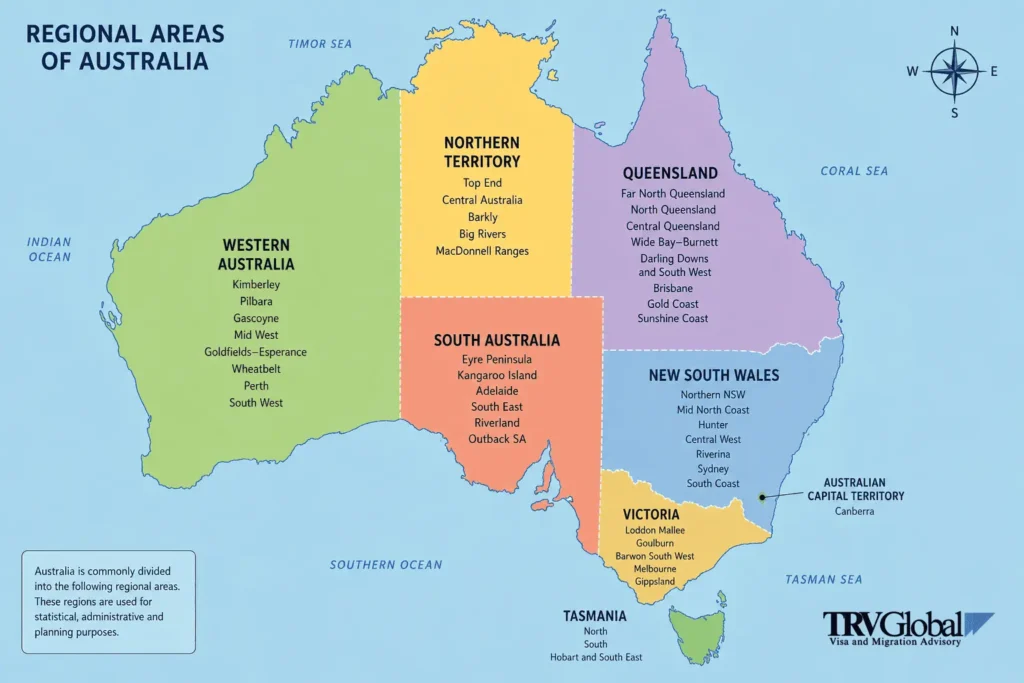
Australia defines regional areas by postcode, not by population size. The following are all officially regional for 491 purposes:
- Perth — capital of Western Australia, population 2.1 million
- Adelaide — capital of South Australia
- Canberra — the national capital (ACT)
- Hobart — capital of Tasmania
- Gold Coast and Sunshine Coast — major Queensland cities
- Geelong and Mornington Peninsula — Victoria
- Newcastle and Wollongong — New South Wales
These are fully functioning cities with universities, hospitals, international airports, shopping districts, and competitive job markets. Regional does not mean remote. It is an administrative classification, not a lifestyle downgrade.
Cities Where 491 Holders Cannot Live
You cannot reside in:
- Sydney (and greater metropolitan area)
- Melbourne (and inner metropolitan suburbs)
- Brisbane
If you breach this condition and live in one of these cities without permission, you violate your visa condition (8579), which can affect your ability to apply for permanent residency later.
Region vs State — What Is the Difference?
This is a common point of confusion.
A state is a political and administrative territory — New South Wales, Victoria, Queensland, and so on. A region is a geographic classification used specifically for migration purposes.
Some states are entirely regional for 491 purposes. This means a 491 holder can live anywhere within that state without restriction:
- Western Australia — the entire state is regional
- South Australia — the entire state is regional
- Tasmania — the entire state is regional
- Northern Territory — the entire territory is regional
- ACT (Canberra) — the entire territory is regional
In Queensland, everything outside Brisbane is regional. In New South Wales, everything outside Sydney, Newcastle, and Wollongong is regional. In Victoria, everything outside metropolitan Melbourne is regional — including Geelong, Ballarat, and the Mornington Peninsula.
The 15-Point Advantage
The 491 gives you 15 bonus points simply for receiving state or territory nomination — or for being sponsored by an eligible family member living in regional Australia.
This is three times the 5-point bonus offered by the 190 visa. In a points system where the difference between an invitation and years of waiting can be 5 to 10 points, 15 points is transformational.
Example: A candidate sitting at 70 base points immediately reaches 85 with a 491 nomination — putting them in a competitive range for most occupations and most states.
Who Can Apply
- Under 45 years old at the time of invitation
- Occupation on the MLTSSL or STSOL (wider than the 189)
- Positive skills assessment from the relevant authority
- Minimum 65 points (including the 15-point nomination bonus — so your base score needs to be 50+, though in practice competitive scores are 70–80+ base)
- At least Competent English (IELTS 6.0 in each band or equivalent)
- Meet health and character requirements
- You can also apply if an eligible relative sponsors you — they must be an Australian citizen, permanent resident, or eligible NZ citizen living in a regional area.
The Pathway to PR — Subclass 191
- The 491 is provisional, not permanent. But it converts to permanent residency through the Subclass 191 visa after:
- Living in a designated regional area for 3 years
- Working in a skilled occupation for those 3 years
- Meeting a minimum income threshold each year
- Once granted the 191, all regional conditions lift completely. You can then live and work anywhere in Australia — including Sydney and Melbourne — as a permanent resident.
Why the 491 Is Popular Among Bangladeshi Migrants
The 491 attracts significant interest from Bangladesh for practical reasons:
Points gap is the core reason. Bangladeshi applicants — particularly engineers, IT professionals, and accountants — frequently score in the 65–80 range on the points test. That score is not enough for a 189 invitation, which in 2025–26 typically requires 85–95+ points. The 491’s 15-point bonus bridges that gap and brings thousands of applicants into invitation range.
English test pressure. Reaching Superior English (20 points) is difficult for many applicants. The 491 makes the difference less critical — those 15 nomination points compensate for scoring Proficient rather than Superior English.
Occupation flexibility. The 491 accepts occupations from both the MLTSSL and the STSOL. Many Bangladeshi professionals — particularly in civil engineering, construction, and business — work in occupations that appear on the STSOL but not the MLTSSL. The 491 opens the door where the 189 keeps it closed.
Family consideration. Perth and Adelaide — both fully regional, both capital cities — offer international schools, Bangladeshi community networks, halal food options, and stable employment. The sacrifice of avoiding Sydney or Melbourne feels manageable when the destination is a major city with full urban infrastructure.
Clear PR timeline. Three years of regional work leads directly to a 191 permanent visa. For a Bangladeshi family planning long-term migration, that certainty matters more than the provisional label.
Key Numbers for 2025–26
Total 491 places: 7,500 (down 23% from the previous year)
Largest state allocation: Western Australia — 2,200 places
Visa duration: 5 years provisional
PR eligibility: After 3 years via Subclass 191
Application fee: Approximately AUD 4,640 for the primary applicant