
Skilled Migration to Australia from Bangladesh in 2026
The Australian Government has been taking in migrants every year to fill gaps in its skilled manpower. Australia, a big country by size, still has many vacant lands, and its economy may not be sustainable without immigrants. Therefore, the Australian Government runs EOI draws monthly or quarterly in order to invite the best candidates to live in Australia permanently.
On this page, we explore the Australian Skilled Migration Program, including its requirements, costs, steps, and pros and cons.
Benefits of skilled migration to Australia
- Permanent residency and citizenship: Australia offers direct permanent residency to skilled individuals, allowing them to live indefinitely and eventually obtain Australian citizenship for themselves and their eligible family members.
- Livable country: Australia is consistently ranked among the world’s most livable countries.
- Safety and security for children: Australia is considered a safe and secure country for children to grow up in
- Free world-class education: Your children can avail world-class education at the best schools
- Free world-class medical: Australian citizens can access world-class healthcare through one of the most advanced medical systems in the world.
- High paid jobs: Australia skilled migration programs welcome talented professionals by offering competitive employment opportunities.
Skilled migration visa categories:
Australia offers three distinct pathways under its skilled migration framework:
- Skilled Independent visa (subclass 189)
- Skilled Nominated visa (subclass 190)
- Skilled Work Regional (Provisional) visa (subclass 491)
These visas are designed to attract experienced professionals to support Australia’s economic growth and labour demands.
189, 190 and 491 visa difference
Many applicants often get confused about the Australia skilled visa subclasses. The table below will help you understand the differences among visa subclasses 189, 190, and 491.
| Facts | Subclass 189 | Subclass 190 | Subclass 491 |
| Permanent Residency? | Yes | Yes | No |
| Can Live Anywhere? | Yes | No | No |
| Nomination Required? | No | Yes | Yes |
| Visa Duration? | Indefinite | Indefinite | 5 Years and apply for PR after 3 years |
| Free education for kids? | Yes | Yes | Yes |
Subclass 189: The Skilled Independent
If you are planning to migrate to Australia and find yourself highly eligible, and your occupation is on the MLTSSL, you can submit an Expression of Interest (EOI) for the 189 visa and receive an invitation for direct permanent residency (PR). Subclass The Subclass 189 visa is a points-tested migration system where you must score at least 65 points to be eligible.. Australia skilled migration, under the Visa subclass 189 is currently highly competitive, and the Department of Home Affairs controls the invitation process for all occupations in this category.
Requirements for subclass 189
- Age: Your age must be between 25 and 45
- Qualification: You must have a bachelor’s degree
- Work Experience: You must have at least 3 years’ work experience
- English Score: IELTS 6 in each band or higher, or equivalent in PTE or TOEFL
- Occupation: Your occupation must be available on the skilled occupation list
- EOI Invitation: You must get an invitation to lodge a visa
Points Calculator – Do you score 65?
Subclass 190: Skilled Nominated Visa
If you are looking to immigrate to Australia from Bangladesh, the Subclass 190 visa is for skilled workers who want to live and work in Australia with support from an Australian state or territory. If your occupation is in demand in a particular state and you meet the eligibility criteria, you can submit an Expression of Interest (EOI). If a state nominates you, you may receive an invitation to apply for permanent residency. This visa allows you to live, work, and settle permanently in Australia, but you must stay in the nominating state for a certain period. Once you migrate to Australia, you can sponsor your spouse through Australia spouse visa.
Requirements for Subclass 190
- Age: You must be under 45 years of age at the time of invitation
- Qualification: A bachelor’s degree or equivalent qualification is required
- Work Experience: At least 2–3 years of relevant work experience
- English Language: Minimum IELTS 6 in each band or equivalent score in PTE or TOEFL
- Occupation: Your occupation must be listed on the state’s skilled occupation list
- State Nomination: You must receive nomination from an Australian state or territory
- EOI Invitation: You must receive an invitation to apply for the visa
Subclass 491: Skilled Regional (Provisional) Visa
The Subclass 491 visa is designed for skilled workers who are willing to live and work in regional Australia. This visa is temporary, but it provides a clear pathway to permanent residency after meeting specific conditions. To apply, you must be nominated by a regional state or sponsored by an eligible family member living in a regional area. This visa helps Australia support growth in regional locations.
Requirements for Subclass 491
- Age: You must be below 45 years of age
- Qualification: A recognized diploma or bachelor’s degree
- Work Experience: At least 1–3 years of skilled work experience
- English Language: IELTS 6 in each band or equivalent in PTE or TOEFL
- Occupation: Your occupation must be on the relevant skilled occupation list
- Nomination or Sponsorship: You must receive state nomination or family sponsorship
- EOI Invitation: An invitation is required before applying for the visa
- Regional Commitment: You must live and work in a designated regional area
Skilled Occupation List
If you are planning to migrate to Australia through skilled migration, it is crucial that your occupation appears on the Skilled Occupation List. This official list highlights the professions currently in demand across the country and ensures that applicants possess skills that meet Australia’s workforce needs. Each listed occupation has a corresponding ANZSCO code and an assessing authority responsible for verifying your qualifications and work experience. Reviewing the list before applying is essential, as it determines eligibility for visas like Subclass 189, 190, and 491. Only candidates with occupations on the list have a higher chance of a successful migration outcome.
What Are the Steps?
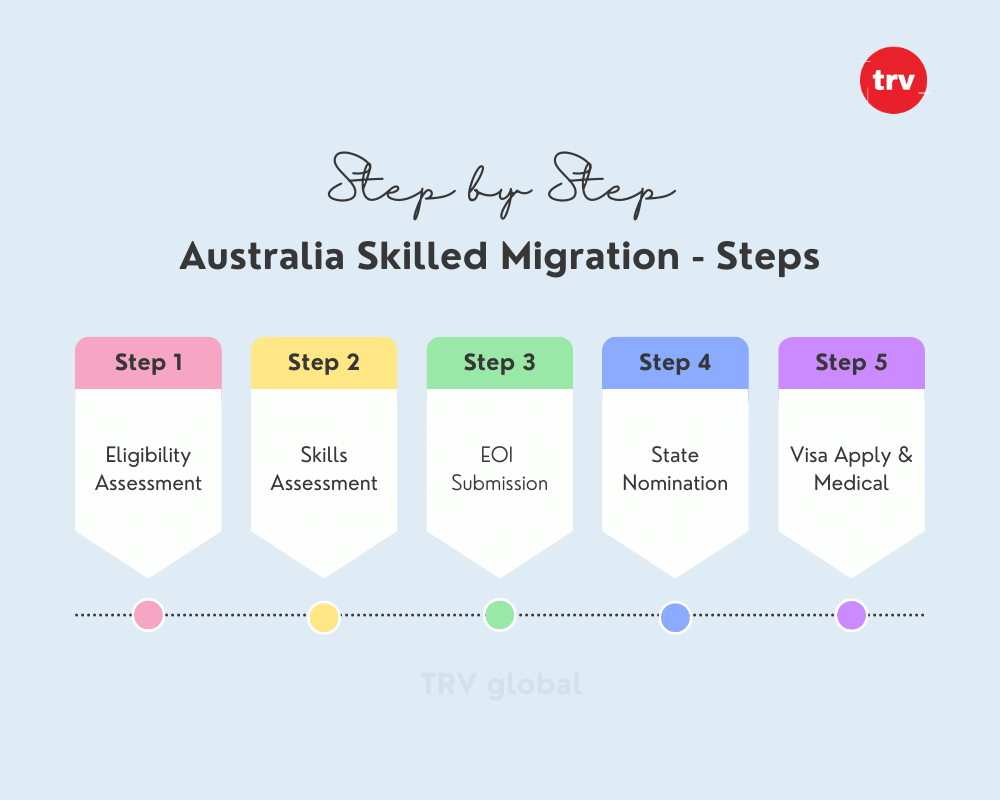
- Step 1: Eligibility Assessment: Confirm that you meet all visa criteria and fulfil all requirements for Australia’s skilled migration program.
- Step 2: Get Positive Skills Assessment: Get a positive skills assessment outcome from an assessing authority in Australia.
- Step 3: Submit Your EOI: Submit an Expression of Interest.
- Step 4: Apply for State Nomination: If you wish to apply for 190 and 491, you must apply for state nominations.
- Step 5: Lodge Visa Application: Submit your visa application within 60 days of receiving the EOI invitation.
Total Costs
- Skills Assessment Fees: Each authority has its own fee structure. For example, VETASSESS charges AUD 1,096, and ACS and Engineers Australia have their own fee structures.
- State Nomination Fees: States have different fee structures. They will charge you once they grant your state nomination. Their fees are approximately AUD 500 to AUD 1,000
- Visa Fees: Main Applicant: ~AUD 4,910, Spouse: ~AUD 2,385 – 2,455, Dependent Child (under 18): ~AUD 1,195 – 1,225. Check updated visa fees.
What are the challenges
There are several challenging factors in the process. First, you must understand that you are one of many applicants, and the entire system is invitation-based. If you do not receive an Expression of Interest (EOI) invitation or a state nomination, your application will not progress. Only after receiving an EOI invitation or state nomination can you realistically expect a successful migration outcome.
Another important factor that can lead to rejection or long delays is an incomplete application. Australia’s skilled migration process involves multiple steps, and if any stage is handled incorrectly, you may receive no outcome at all or remain waiting for years without clear reasons.
Australian Registered Agent in Bangladesh
TRV Global works with top MARN-registered agents and experienced immigration lawyers in Australia, who can represent you and submit your applications on your behalf. Get a free eligibility assessment and take steps to settle in Australia.
FAQ
You may qualify for skilled migration Australia if you meet the eligibility requirements under Australia’s General Skilled Migration (GSM) program. Your occupation must be listed on the current Skilled Occupation List, and you must have relevant qualifications or proven work experience in your field. Applicants are also assessed on age, English language ability, skilled employment, education, and overall points score. Meeting the minimum points threshold does not guarantee an invitation, but it allows you to enter the selection pool.
For most Australia skilled migration visas, the minimum English requirement is Competent English. This usually means an IELTS score of at least 6.0 overall, with a minimum of 6.0 in each band. Higher English scores such as Proficient or Superior English can earn extra points in the points test and improve invitation chances, especially in competitive occupations.
Yes, scoring 75 points gives you a strong chance of receiving an invitation for Australian Permanent Residency. While the minimum requirement is 65 points, invitations are often issued to applicants with higher scores due to competition. Factors like state nomination, higher English scores, and skilled work experience can further strengthen your profile.
Australian Permanent Residency does not expire. However, the travel facility attached to the PR visa is typically valid for five years. If you remain outside Australia for an extended period, you may need a Resident Return Visa to re-enter. As long as residency obligations are met, PR status itself remains valid.
PTE Academic results are valid for two years for Australia skill migration visa applications. Your English test must be valid at the time you receive an invitation and when you submit your visa application. Always check test validity dates before lodging your Expression of Interest.
Australia continues to face skill shortages in healthcare, IT, engineering, construction, education, and trade occupations. Roles such as nurses, software engineers, electricians, civil engineers, aged care workers, and teachers remain in high demand. Occupation lists are updated regularly, so applicants should review the latest lists before applying.
Do You Have Questions?
We are open to answering all your questions and providing you with the best possible solutions.